

Solar Splash
By: Luke Ventstrom | Contributor | Jun 3, 2026
Photo: Solar Splash
Solar Splash: Where Solar Energy, Engineering, and Students Come Alive
Each summer, on a stretch of water in Springfield,Ohio, teams of undergraduate engineering studentsgather to race solar-powered boats in the SolarSplash, an intercollegiate competition sponsored andrun by members of the Solar Energy Division, includingformer division chairs Drs. Jeffrey Morehouseand Roy Hogan. The competition is a remarkablydurable pipeline for turning students studying engineeringin the classroom into engineers puttingtheir knowledge and skills into practice. The boatstake center stage at the competition, but the lastingstory is what happens to the students who buildthem: they learn to solve messy problems underpressure, communicate across disciplines, and buildconfidence that can be hard to acquire in coursework.
Steven Guo, an electrical engineering student at Carnegie Mellon University, joined his team because he wanted more than theory. “Theory can only take you so far. Being able to actually apply the things I learned in class was very helpful.” That hands-on experience also gave him an edge in the job market. Solar Splash became “one of the biggest things” he could talk about in interviews, and he credits it as decisive in shaping his professional trajectory. “I can say with very high confidence that the reason I have my job today is because of joining the Solar Splash team.” “Everybody at school takes classes. But 500 kids are not out here building solar boats.” —Steven Guo(Carnegie Mellon University) At Cal Poly Pomona, mechanical engineering graduate Talia Dorian came to Solar Splash through a different path: a deep interest in renewable energy and climate action. “I am really passionate about renewable energy and the fight against climate change, and when I found out that our school had a Solar Splash team, it just seemed like the perfect match.” She discovered the team almost by accident, learning in aserendipitous lunch conversation that the team had existed for two decades outside of the spotlight. That began to change quickly. “We went from six people at the start of last year to around eighty at the start of this year,” Talia said, as the team gained visibility and momentum.
Talia’s experience also highlights how Solar Splash mirrors real engineering practice, especially for teams rebuilding after pandemic disruptions. Cal Poly Pomona lost much of its institutional knowledge during COVID shut downs, so student leaders traveled to the competition simply to observe and learn beforeattempting to build again. From there, the challenge was immense: construct a competitive boat in asingle year with limited funding. “We got about $6,000 from the school, and by the end of it, we ended up spending $20,000.” Fundraising, material reuse, and creativity became as essential as technical skill.
The competition tested those efforts immediately. The team’s newly built hull took on water during races,forcing improvised repairs on the fly. “We spent basically two races covering the entirety of the bottom 3 with flex tape and silicone,” Talia recalled, while also relying on a bilge pump to keep the boat afloat. Carnegie Mellon’s boat glides through the water.
Faculty advisors note that such real-world engineeringchallenges are at the core of the competition. Professor Peter Vorobieff from the University of New Mexico emphasizes that Solar Splash is designed tokeep barriers to entry low while still demandingserious engineering. Teams can pursue simple orsophisticated designs, but all must confront thesame real-world constraints: delayed parts, logisticalhurdles, on-site assembly, and the unpredictable behavior of complex systems under load. These challenges,he argues, are where the deepest learninghappens.
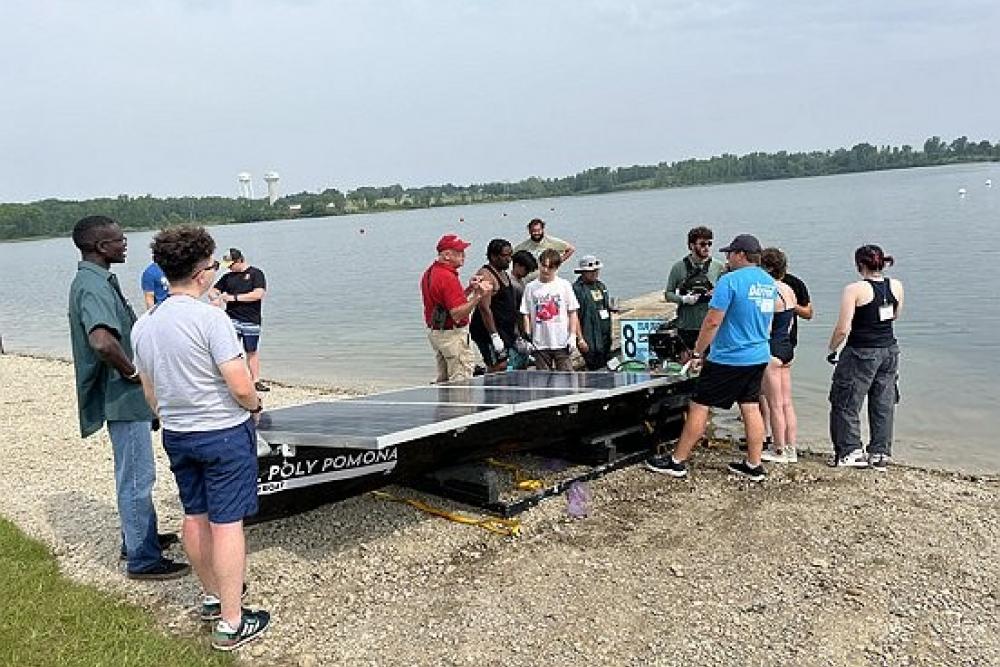
Another defining characteristic of Solar Splash is the spirit of cooperation among and between teams. Talia described how experienced teams openly mentornewer ones, even potential rivals. “This is a competition, but it’s not cut throat. Everyone is there for renewable energy, for engineering, for the loveof the game.” When a cracked battery threatened to end Cal Poly Pomona’s run, another team stepped in without hesitation. “They asked, ‘Do you want to borrow ours?’” she said. The gesture left a lasting impression. Steven Guo observed the same culture from his perspective, noting that teams routinely help each other troubleshoot problems and share tools as if every boat on the water were their own.“I learned more in the one year that we were building the boat than I have in my entire time in college”—Talia Dorian (Cal Poly Pomona)Culture of cooperation: Other teams help launch the Cal Poly Pomona boat.
For Talia, the most powerful lessons were not purely technical. One moment stands out: after discoveringa major hull failure, the team gathered for lunch,exhausted and discouraged. “The president of theteam just started crying and said, ‘I wouldn’t wantto be here with anyone else than the team that’sin front of me right now.’” What followed was acollective recommitment. Teams from across thecompetition helped lift their waterlogged boat inand out of the lake. “Seeing not only our team, butthe rest of the competition come together to helpus, that was huge.” By the end of the event, theteam received the Perseverance Award, recognitionthat resilience matters too.
Solar Splash also reshaped how Talia understoodherself as an engineer. “I learned more in the oneyear that we were building the boat than I have inmy entire time in college”, she said. The experiencehelped quiet long-standing doubts about belongingin engineering. “Being able to connect my interest in renewable energy with engineering shook me out of that headspace and gave me confidence that I didn’thave before.”
When asked what advice she gives to new students considering Solar Splash, Talia did not hesitate. “Believein yourself, believe in your team, you have the skills.” It is advice commonly given to athletes that competeunder pressure, but it is equally applicable to students in Solar Splash. When asked the same question,Guo shared that “it’s okay to be confused”, and students should not hesitate to ask questions becausequestions are how practicing engineers learn.
Solar Splash remains a vivid expression of why our division exists: to advance solar energy while cultivating engineers who can design, adapt, and persevere. The competition produces boats that move with motorspowered by the sun, but more importantly, it produces engineers who understand that engineering is ahuman enterprise, powered as much by collaboration and resilience as by engineering models and technology.
Latest Headlines
- 2027 Board of Directors and Council-at-Large Results
- 2027 APBA National Meeting - Room Reservation Block is OPEN
- 2027 APBA Board of Directors and Council at Large Elections
- Trackside Registration Directions
- 2026 Stock Outboard National Champions
- Jimmy Shane Takes Home Sixth APBA Gold Cup
- APBA Gold Cup Returns to Madison for Historic 116th Running
- Solar Splash
- United States Awarded 2027 UIM Jet Sprint World Championship
- ROAD TO MONACO: RWO LANDS HISTORIC UIM AGREEMENT
- Springfield, OH Spring Test and Tune
- APBA A GEARCASE
- Implementation Trackside for APBA Event Racer Registration
- West Coast Upcoming Dunk Certifications
- Harbor Freight Tools for Schools Fuels Expansion
- APBA Safety Capsule Training 2026